
The problem
Railway asset owners and their contractors are being squeezed between two opposing forces. On the one hand they are gathering more railway data every year comprising of measurements, inspections, and IOT-data. On the other hand the domain specialists that work with this data are retiring. This creates a daunting task. How to create actionable information from this ocean of data with less and less people? This is where RailDB comes in. RailDB is an ecosystem of tools specialized to turn rail data into information.

The standard process
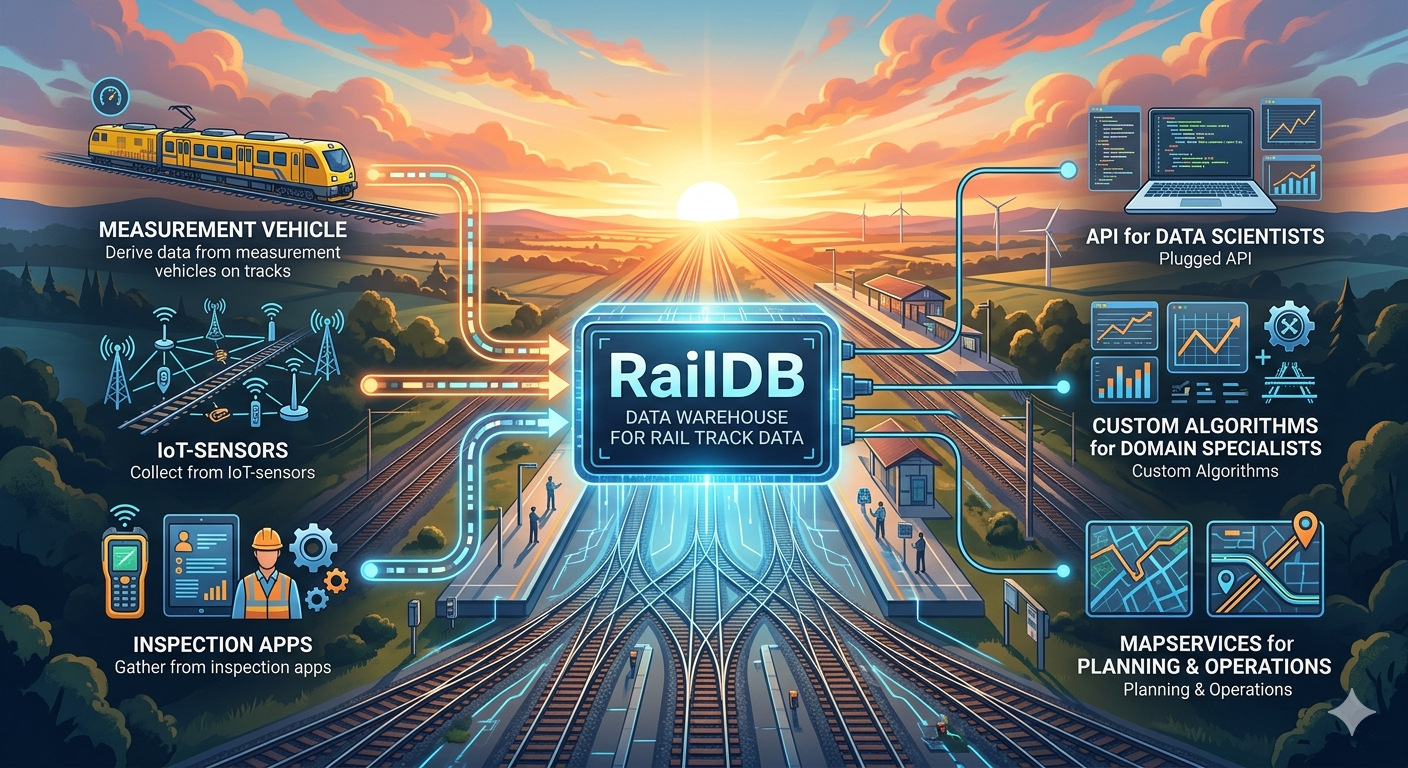
Rail condition data is gathered with measurement vehicles, inspection apps and IOT-sensors, routed on a topological railway model and imported into a visualization and analysis tool. A popular tool for rail data is IRISSYS, however systems like RailCloud, RAMSYS or Business Intelligence tools provide similar functionality to a certain extent.

The status quo
Traditionally, the data is analyzed manually by domain specialists and locations of interest are marked for further inspection or maintenance. This manual analysis process is extremely tedious and time consuming and requires in-house domain knowledge.
In addition, railway operators and contractors increasingly hire data scientists to create insights, support maintenance planning and business decisions. Facilitating these scientists with large quantities of structured linear measurement data for business intelligence and data analysis requires a very significant investment in time and resources.

The solution
This is where RailDB shifts the paradigm by providing a specialized linear asset management datawarehouse with automated analyses for geometry, wear and many other topics. This way we can create more insights in less time and make the data work for you instead of the other way around.
Why use RailDB?
The most important reasons to use RailDB:
- Automate repetitive data analysis tasks. This greatly improves work satisfaction and efficiency for analysts.
- Capture part of the domain knowledge in custom algorithms. This prevents knowledge leaking out of your organisation.
- Reduce complexity for analysts by absorbing it in custom algorithms. This is necessary in a world with ever proliferating contract requirements.
- Assuring quality of analysis, since (rule-based) algorithms don’t make mistakes and don’t get tired.
- Quick and easy access to large amounts of highly structured data. This is a condition for succesful data science in your organisation.
